Lionel Messi has announced his retirement from international football, closing a 21-year chapter with Argentina that produced 207 caps, 125 goals, and the nation's first World Cup title in 36 years. The 39-year-old Inter Miami forward confirmed the decision on 31 August 2026, six weeks after captaining Argentina to a second consecutive World Cup final, where La Albiceleste fell 1–0 to Spain in extra time. Messi departs as Argentina's most-capped player and all-time leading scorer, describing the choice as one that "hurts [his] soul deeply."
The decision ends one of the most decorated international careers in football history and answers, at last, the question that has shadowed the eight-time Ballon d'Or winner for years: when would the sport's most celebrated player finally surrender the number 10 shirt that became synonymous with his name?
Messi Steps Away as Argentina's Most Decorated Player
The announcement, reported first by The Times and The Athletic, arrived little more than a month after the 2026 World Cup final at MetLife Stadium. Messi had entered the tournament intent on defending the title he won in Qatar in 2022, and he did everything in his power to deliver it again — registering eight goals and four assists across the competition, enough to earn the Silver Boot as its second-highest scorer and the Silver Ball as its second-best player.
Yet the ultimate prize eluded him. Argentina reached the final for the second straight tournament but lost 1–0 to Spain after extra time on 19 July, as Luis de la Fuente's side — riding a 37-match unbeaten run and stacked with talents such as Lamine Yamal, Pedri and Fabián Ruiz — claimed the country's second World Cup. For Messi, it was a heartbreaking end to a campaign in which he had briefly stood alone as the all-time leading World Cup goalscorer of any gender with 17 goals, surpassing Miroslav Klose and Marta, before Kylian Mbappé overtook him later in the tournament.
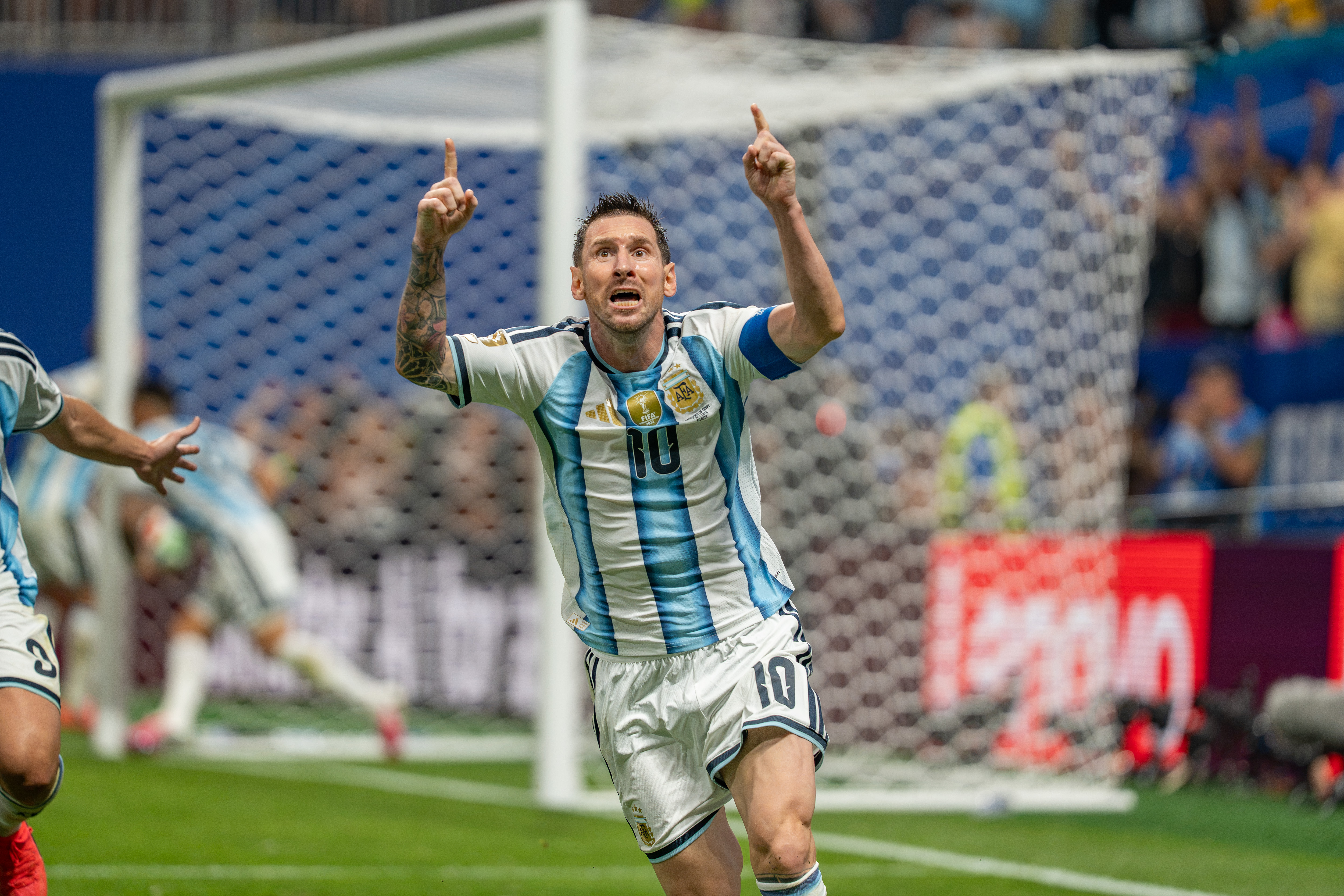
Even in defeat, the numbers underlined Messi's singular brilliance. He set a new benchmark for the most assists in World Cup history with 12, and his 207 international appearances and 125 goals both stand as Argentina records. The trophy cabinet he leaves behind includes the 2021 Copa América, the 2022 Finalissima, the 2022 FIFA World Cup, the 2024 Copa América, and an Olympic gold medal from Beijing 2008.
From Rosario Prodigy to World Champion: A 21-Year Timeline
Messi's international journey began in August 2005, when the teenage prodigy from Rosario made his senior debut — an appearance cut short by a red card within minutes. The road since has been anything but straightforward.
At the 2006 World Cup he became Argentina's youngest World Cup player and scorer. Heartbreak followed in a run of three consecutive finals lost between 2014 and 2016 — the 2014 World Cup final to Germany, and back-to-back Copa América defeats to Chile — the latter prompting Messi to briefly announce an international retirement in 2016 before a nationwide campaign convinced him to return.
The breakthrough came in 2021, when Messi captained Argentina to the Copa América title, ending a 28-year trophy drought. A year later, he produced one of the defining individual tournaments of all time at the 2022 World Cup, scoring twice in the final against France to secure Argentina's first global crown since 1986. A second straight Copa América followed in 2024, setting up what would ultimately be his farewell campaign in 2026.
Why Messi's Farewell Reshapes the Greatest-of-All-Time Debate
Messi's retirement does more than close an era — it draws a brighter line under the debate that has defined modern football. His eight Ballons d'Or, eight FIFA world's-best awards, and six European Golden Shoes already placed him in a category of one, but the 2022 World Cup triumph supplied the missing piece that critics once held against him. That he returned in 2026 at age 39 and remained Argentina's most dangerous creator, setting an all-time assists record, only reinforced the argument that no player has combined longevity, playmaking and scoring at this level.
Analysts have long noted that Messi evolved as he aged, shifting from a slaloming dribbler to a deep-lying orchestrator who could dictate games from midfield. That transformation was on full display in 2026, where his vision and passing — rather than his once-blistering pace — carried Argentina to the brink of back-to-back titles. As former Barcelona manager Pep Guardiola once said of him, "Messi is the only player that runs faster with the ball than he does without it."
Still the Face of Inter Miami: Messi's Club Career Rolls On
Crucially, Messi's announcement concerned only his international career. He remains under contract with Inter Miami, where he has become the most transformative signing in Major League Soccer history since arriving in July 2023. In 2024 he won the Landon Donovan MLS MVP Award, led the club to the Supporters' Shield and its first MLS Cup, and finished the campaign with 20 goals and 16 assists in 19 matches. In March 2026 he overtook Pelé's long-standing record for career free-kick goals with his 71st.
That Messi is still producing at club level is precisely what makes his international exit feel both premature and inevitable. He remains capable of brilliance, but the physical and emotional toll of a sixth World Cup — combined with the desire to end on his own terms — made 2026 the natural endpoint.
What Comes Next for Argentina — and for Messi
For Argentina, the post-Messi era begins now. Manager Lionel Scaloni, who fell just short of becoming the second coach in history to win multiple World Cups, must rebuild an attack that has flowed through Messi for nearly two decades. The supporting cast — Julián Álvarez, Enzo Fernández and a new generation of Albiceleste talent — will now be asked to carry the load without the gravitational pull of their captain.
For Messi, the immediate future lies in Miami, where he is expected to continue his club career and, eventually, weigh a full retirement from the professional game. Whether he transitions into an ownership or ambassadorial role remains to be seen, but his farewell statement made clear the emotional weight of the moment — a decision, in his own words, that "hurts [his] soul deeply."
The Bottom Line: Messi's International Legacy in Numbers
- 207 caps — Argentina's all-time most-capped player
- 125 goals — Argentina's all-time leading scorer
- 21 years — from 2005 debut to 2026 retirement
- Three major titles — 2021 Copa América, 2022 World Cup, 2024 Copa América
- Eight goals and four assists at the 2026 World Cup, plus the Silver Ball and Silver Boot
- 12 World Cup assists — an all-time record