Twenty years after a single special-teams play turned him into a symbol of New Orleans' resilience, Steve Gleason has returned to the Superdome to mark the anniversary of his iconic blocked punt — a milestone he has reached while far outliving the life expectancy doctors gave him when he was diagnosed with ALS. Diagnosed in January 2011 with amyotrophic lateral sclerosis, better known as Lou Gehrig's disease, the former New Orleans Saints safety was told he likely had three to five years to live. Fifteen years later, the 49-year-old remains one of the most visible advocates for people living with the condition, communicating through eye-tracking technology and breathing with the help of a ventilator.
This week, Gleason led a second line — the brass-band procession that is a hallmark of New Orleans life — through downtown ahead of a "Domecoming" celebration honoring 20 years since the Saints' emotional return to the Superdome after Hurricane Katrina. At the center of that celebration was the play that made Gleason famous: his blocked punt against the Atlanta Falcons on Sept. 25, 2006, less than 90 seconds into the first game the Saints played back in their storm-damaged home stadium.
Inside the 'Rebirth': The Punt Block That United a City
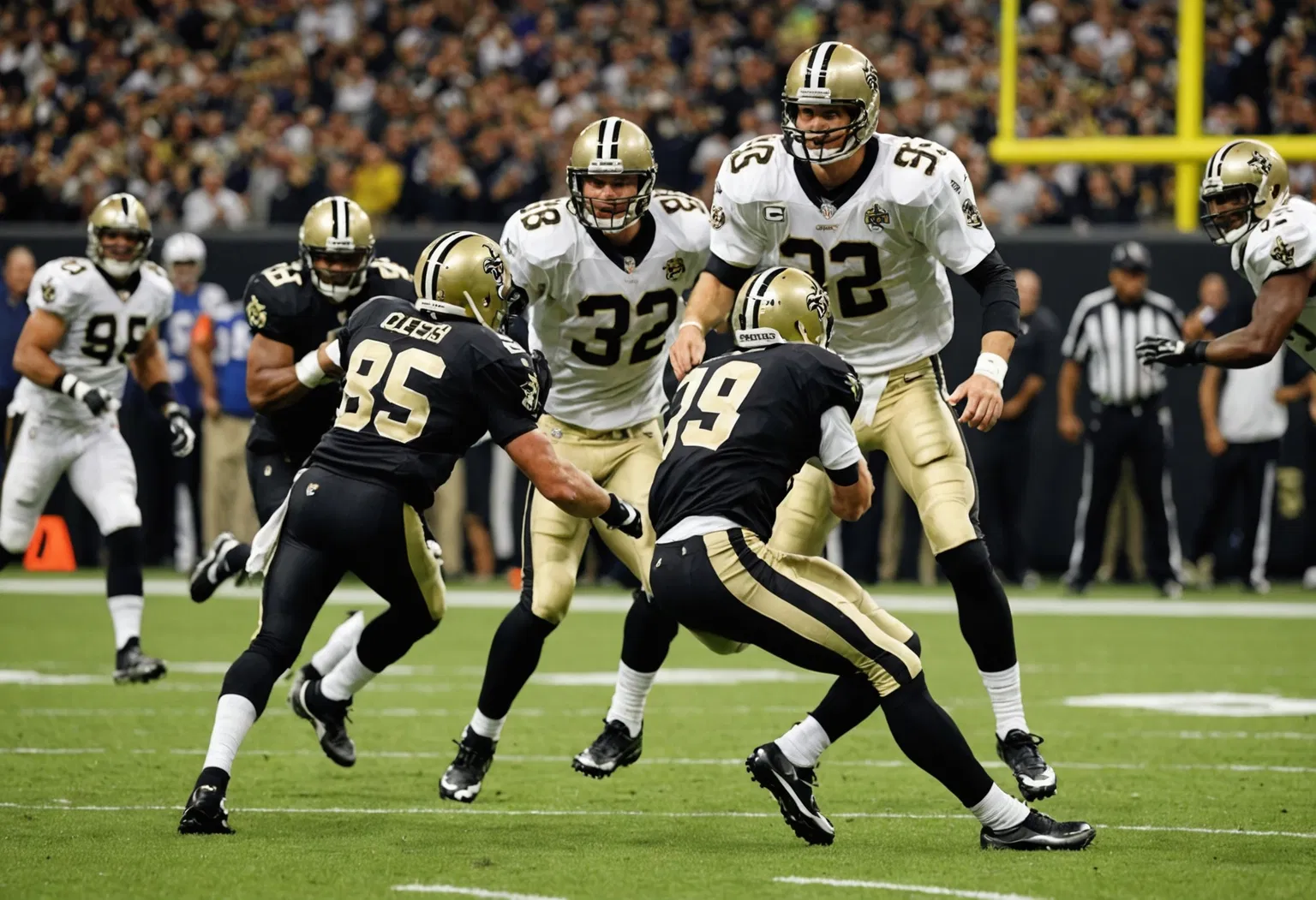
When the Saints finally returned to the Superdome on Monday Night Football on Sept. 25, 2006 — roughly 13 months after Hurricane Katrina flooded New Orleans — the night carried a weight far beyond football. On the Falcons' first possession, with the crowd roaring, Gleason burst up the middle and blocked punter Michael Koenen's kick. Curtis Deloatch recovered the loose ball in the end zone for a touchdown, and the Saints rode the emotion to a 23-3 victory.
The moment, later named the "Rebirth" play, has been enshrined as one of the NFL's most memorable — ranked No. 28 on the league's "100 Greatest Plays" list. In July 2012, the Saints unveiled a bronze "Rebirth" statue outside the Superdome, with likenesses of Gleason and Koenen frozen in that split second. The figures weigh 800 pounds each and stand seven-and-a-half feet tall, mounted on granite stanchions.
Gleason, a Spokane, Washington, native who played college football at Washington State, was never a star in the traditional sense. Undrafted and undersized, he carved out an eight-year NFL career (2000–2008) with the Saints as a hard-nosed safety and special teams ace. That one blocked punt, however, rewrote his legacy — and, by his own telling, may have helped extend his life.
From Historic Block to ALS Diagnosis: The Steve Gleason Timeline
The arc of Gleason's life has been defined by two dates separated by roughly five years — one that lifted a city, and one that changed his own world.
- Sept. 25, 2006: Gleason blocks a punt in the Superdome's reopening game, sparking the Saints' post-Katrina return.
- January 2011: At age 34, Gleason is diagnosed with ALS. Six weeks later, he and wife Michel Varisco learn they are expecting their son, Rivers.
- September 2011: Steve and Michel found Team Gleason, a nonprofit devoted to empowering people living with ALS.
- July 2012: The "Rebirth" statue is unveiled outside the Superdome.
- 2016: The documentary "Gleason" premieres at the Sundance Film Festival and is acquired by Amazon, chronicling his fight and the video journal he recorded for his unborn son.
- 2019: Gleason receives the Congressional Gold Medal, one of the nation's highest civilian honors, for his ALS advocacy.
- July 2024: He accepts the Arthur Ashe Courage Award at the ESPYS and publishes his memoir, "A Life Impossible."
- September 2024: Gleason is hospitalized with low blood pressure in a medical scare but returns home describing himself as "reborn."
- 2026: Fifteen years into his ALS journey, Gleason returns to the Superdome for the 20th anniversary of the blocked punt.
15 Years With ALS: How Gleason Redefined 'Living Impossible'
Most people diagnosed with ALS are told to expect three to five years. Gleason has now lived three times that long, outlasting a disease that progressively paralyzes its victims. He types messages with his eyes — his social media biography reads "I type with my eyes" — and uses a ventilator to breathe, technologies that were once unimaginable for ALS patients.
That longevity, and the quality of life he has fought to preserve, is central to the mission of Team Gleason. Founded in 2011, the organization has raised roughly $65 million to provide people with ALS access to cutting-edge technology, equipment, and support, operating under the philosophy that a terminal diagnosis does not have to mean a diminished existence.
His advocacy has also reached Washington, where Gleason has championed legislation such as the ACT for ALS, which funds access to experimental treatments for patients. The 2016 documentary "Gleason" brought his story — including the raw realities of living with ALS and the video journals he recorded for his son, Rivers — to a global audience.
His honors — the Congressional Gold Medal in 2019 and the Arthur Ashe Courage Award in 2024 — reflect a public life that, in many ways, has been defined more by the years since his diagnosis than by the ones on the field. Reflecting on the symmetry of his story, Gleason has drawn a direct line between the play and his survival. "The truth I have to live with is this: The same play that helped New Orleans breathe again is a big reason I'm still breathing now," he said. The connection forged that night, he believes, helped sustain him through the hardest years of his illness.
Where Things Stand Now: A Second Line and a 'Domecoming'
Two decades after the blocked punt, New Orleans turned out for Gleason again. This week, he led a second line through downtown ahead of the "Domecoming" celebration at the Superdome — an emotional homecoming for a player who has become synonymous with the city's comeback story.
In interviews marking the anniversary, Gleason has remained characteristically humble about his role, insisting the Saints did not single-handedly heal New Orleans. The people, he has said, were already resilient after Katrina — the team simply gave them something to cheer for again.
He has also opened up about the bonds he shares with other former NFL players living with ALS, describing a brotherhood forged through a shared, relentless disease. Those relationships, he said, have become an unexpected source of strength as the years have added up.
What's Next: Continuing to 'Live Impossible'
Gleason's motto — "Live Impossible" — captures the mission he and Team Gleason continue to pursue. The foundation keeps pushing for expanded access to ALS treatments and assistive technology, while Gleason himself continues to write, speak, and advocate using the tools that keep him connected to the world.
As the anniversary celebrations wind down, the work does not. Team Gleason's guiding message — "until there is a cure, there is Team Gleason" — remains at the center of Gleason's life, even as he navigates a disease that has far outlived its expected timeline. For Gleason, the blocked punt was never just a football play; it was a promise he has spent the past two decades keeping.
The Bottom Line: Key Takeaways
- Steve Gleason's blocked punt on Sept. 25, 2006, in the Superdome's post-Katrina reopening became the iconic "Rebirth" play, ranked No. 28 on the NFL's 100 Greatest Plays.
- Diagnosed with ALS in January 2011 at age 34, Gleason was given three to five years to live; he has now survived 15 years.
- With wife Michel, he founded Team Gleason in 2011, which has raised about $65 million to support people living with ALS.
- Gleason has received the Congressional Gold Medal (2019) and the Arthur Ashe Courage Award (2024) and published his memoir, "A Life Impossible."
- Twenty years after the blocked punt, he returned to the Superdome to lead a second line and mark the "Domecoming" anniversary.